


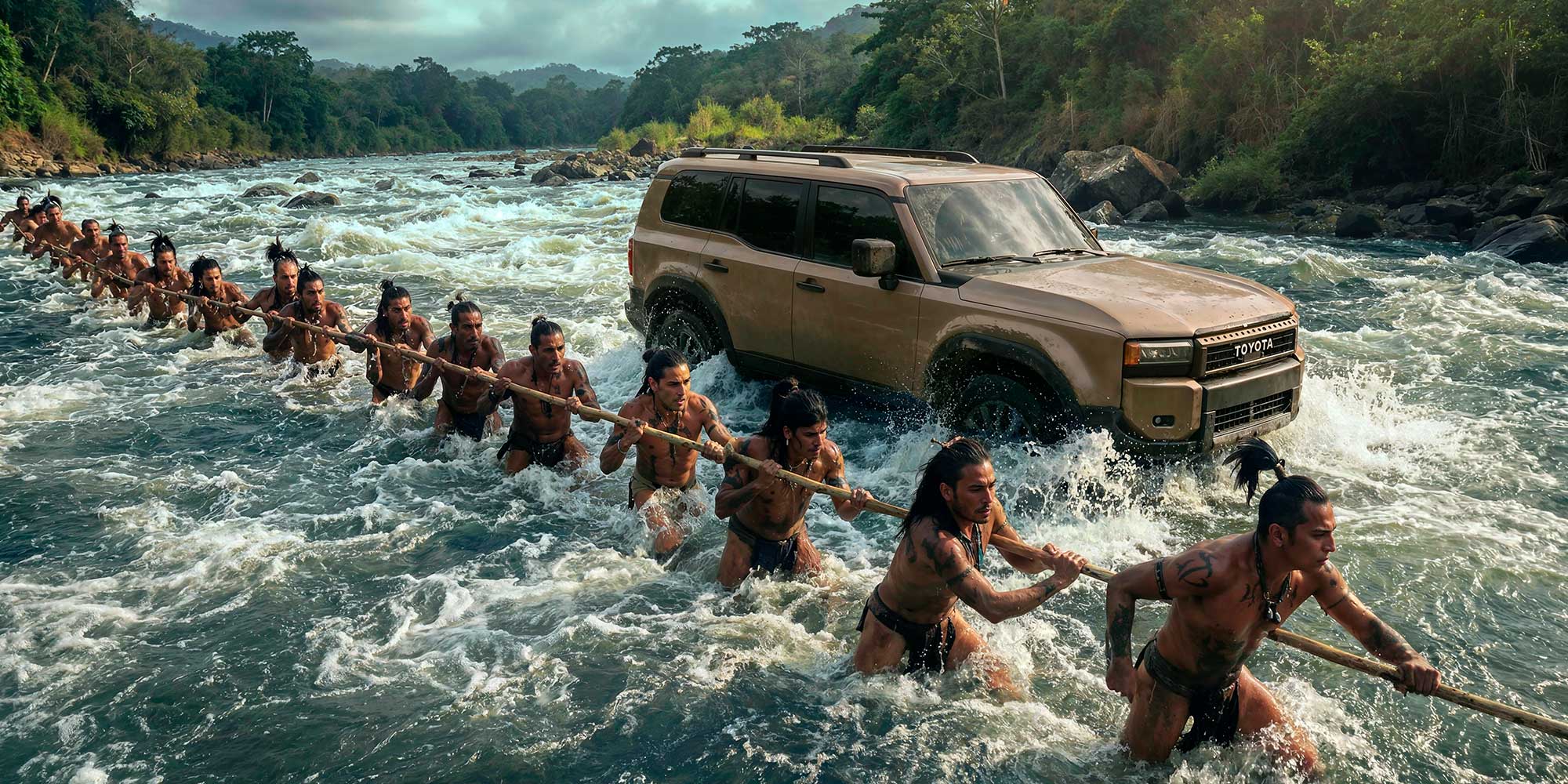


Eclipse of Civilization
Hybrid Visual Production by ehila' and LUZZITELLIDANIELI
In this personal project, we explore the convergence of photography, CGI, artificial intelligence and post-production as components of a single visual production system.
Rather than treating these disciplines as separate techniques, the project investigates how they can operate together to create highly controlled cinematic imagery where realism, imagination and storytelling coexist within the same visual space. The central subject is the iconic Toyota Land Cruiser, entirely recreated in CGI and integrated into AI-generated environments and characters. The final scenes are then refined through extensive photographic thinking and post-production, allowing every element to share a coherent visual language.
The objective was not simply to create a realistic vehicle rendering, but to construct a believable world around it.
The process began with visual research inspired by mythology, tribal cultures, cinematic world-building and adventure narratives. AI was used to develop environments, atmosphere and characters, while CGI provided complete control over the vehicle's form, materials and lighting behavior. By combining these layers, we were able to create images that move beyond traditional rendering or image generation, occupying a hybrid territory where technology becomes a creative instrument rather than an end result.
Every image was directed with the same principles that guide photographic production: Light as narrative structure Composition as visual hierarchy Materials as a source of realism Atmosphere as emotional language Post-production as visual unification
The eclipse visible in the scene acts as a symbolic element, reinforcing the tension between nature, mythology and technology. The Land Cruiser becomes more than a vehicle; it becomes a protagonist within a larger fictional universe. This project reflects our ongoing exploration of contemporary image-making, where photography, CGI and AI are no longer isolated disciplines but interconnected tools within a single creative workflow.
The future of visual production is not about choosing between technologies.
It is about directing them.
LET'S CREATE